
Maximize Your Advertisement ROI with Dayparting: Reach the Right People at the Right Time
In the competitive world of Amazon PPC, the key to success isn’t just about how much you bid—it’s about when you bid. Dayparting in Amazon advertising allows you to reach the right people at the right time, ensuring that your ads are placed during high-conversion timeframes, rather than being wasted on window shoppers.
By strategically adjusting bids during peak shopping hours, you can improve ad visibility and optimize your budget allocation. This blog will guide you through how to leverage dayparting strategies to lower ACoS, maximize ROAS, and ensure your campaigns run at their most efficient.
Table of Content
- The Critical Role of Timing in Amazon PPC Campaigns
- Comparison of Standard Amazon PPC vs. Amazon PPC Dayparting Strategies
- Step-by-Step Guide to Implementing Amazon PPC Dayparting
- Key Amazon PPC Dayparting Strategies for Sellers
- Best Practices of Dayparting for Amazon PPC
- Limitations & Challenges of Dayparting for Amazon PPC
- How Data4Amazon Can Help with Amazon PPC Optimization?
The Critical Role of Timing in Amazon PPC Campaigns
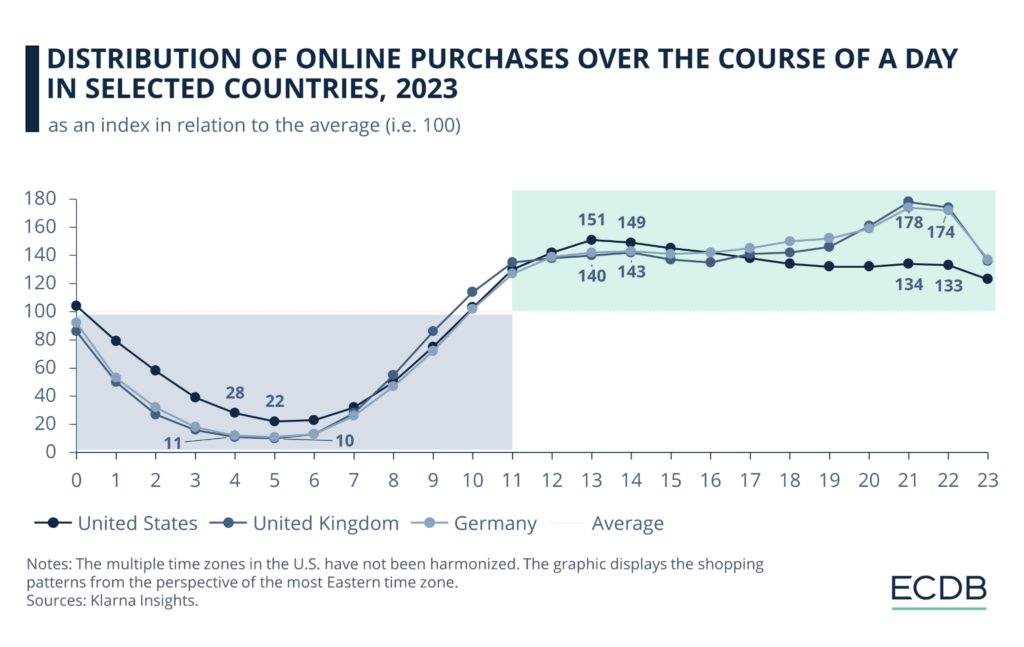
Consumer Shopping Behavior and Intent: Consumer engagement with advertisements peaks at specific times of day. For example, in the US, shopping activity surges around midday (approximately 11 AM–2 PM). Dayparting enables sellers to strategically optimize ad spend by aligning it with peak shopping hours (the best time to run Amazon PPC ads), thereby increasing the likelihood of conversion.
Increased Ad Relevance: Ads placed during high-traffic times tend to generate higher engagement and, therefore, more CTR. Amazon’s algorithm prioritizes listings with higher CTR, which can improve your ad’s relevance and placement throughout the day. Higher relevance enhances your ad’s visibility, enabling you to secure top placements at a reduced CPC, thereby maximizing the efficiency of your ad spend.
Comparison of Standard Amazon PPC vs. Amazon PPC Dayparting Strategies
| Aspect | Standard Amazon PPC | Amazon PPC Dayparting |
|---|---|---|
| Bid Strategy & Budget Allocation | Fixed bids and even budget distribution across the entire day, with no time-specific adjustments. | Dynamic bid adjustments and strategic budget allocation focused on high-conversion timeframes. |
| Ad Schedule | Runs 24/7 with either fixed or daily dynamic bids. | Ads are scheduled to run or pause during specific, high-performance time blocks. |
| Real-Time Adjustments | No real-time bid adjustments; manual updates needed. | Real-time bid adjustments via third-party tools based on hourly performance data. |
| Level of Complexity | Basic, simple setup and management. | Advanced, requiring ongoing data analysis and hourly bid adjustments. |
| Tools Required | Amazon Seller Central and basic ad tools. | Amazon Ads Console and third-party tools (e.g., Pacvue, Perpetua). |
| Scalability | Suitable for businesses with steady, consistent demand. | Best for businesses with fluctuating traffic and specific peak times. |
| Ad Visibility & Placement | Consistent visibility across the day. | Improved ad visibility and placement during high-conversion hours. |
| Return on Investment (ROI) | Steady ROI, but may miss high-conversion opportunities. | Potential for higher ROI by optimizing ad spend during peak conversion periods. |
Step-by-Step Guide to Implementing Amazon PPC Dayparting
Step 1: Historical Campaign Data Collection & Analysis
Use Amazon’s Marketing Cloud or SP hourly reports from Amazon Marketing Stream to assess hourly performance. Focus on key metrics such as clicks, conversions, ACoS, and CVR to identify high-conversion timeframes (e.g., 12 PM–8 PM) and low-performing timeframes.
Step 2: Adjust Budget & Bids for Peak and Off-Peak Hours
Based on the data, identify the peak and off-peak hours of consumer engagement. Then implement these two strategies;
1. Set Up Budget Rules via Amazon Ads Console or Amazon Ads API
Configure schedule-based budget rules to automatically increase the budget during high-conversion periods (e.g., 12 PM – 2 PM).
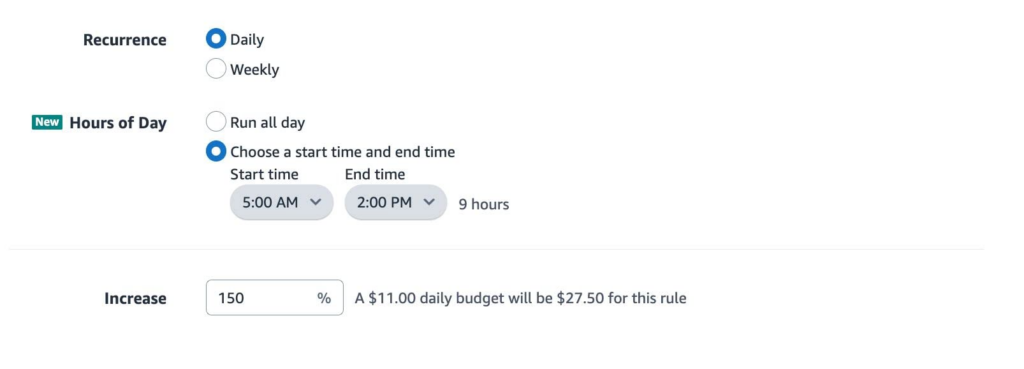
Note: While schedule-based rules are central to dayparting, performance-based rules adjust the campaign budget based on overall performance metrics and are not tied to specific hours of the day.
When applying schedule-based and performance-based budget rules simultaneously, the budget increases are cumulative if both rule conditions are met. For instance, if one rule increases the budget by 30% on Prime Day and another rule increases it by 15% for campaigns meeting a ROAS threshold (performance-based), the budget will increase by 45% on that day if both conditions are satisfied.
2. Set Up Bidding Rules via Amazon Ads Console or Amazon Ads API
Configure schedule-based bid rules to set bids in advance for high-conversion periods, such as during special events (e.g., Prime Day, Halloween) or specific days (e.g., Saturday and Sunday evenings, 5 PM – 9 PM).
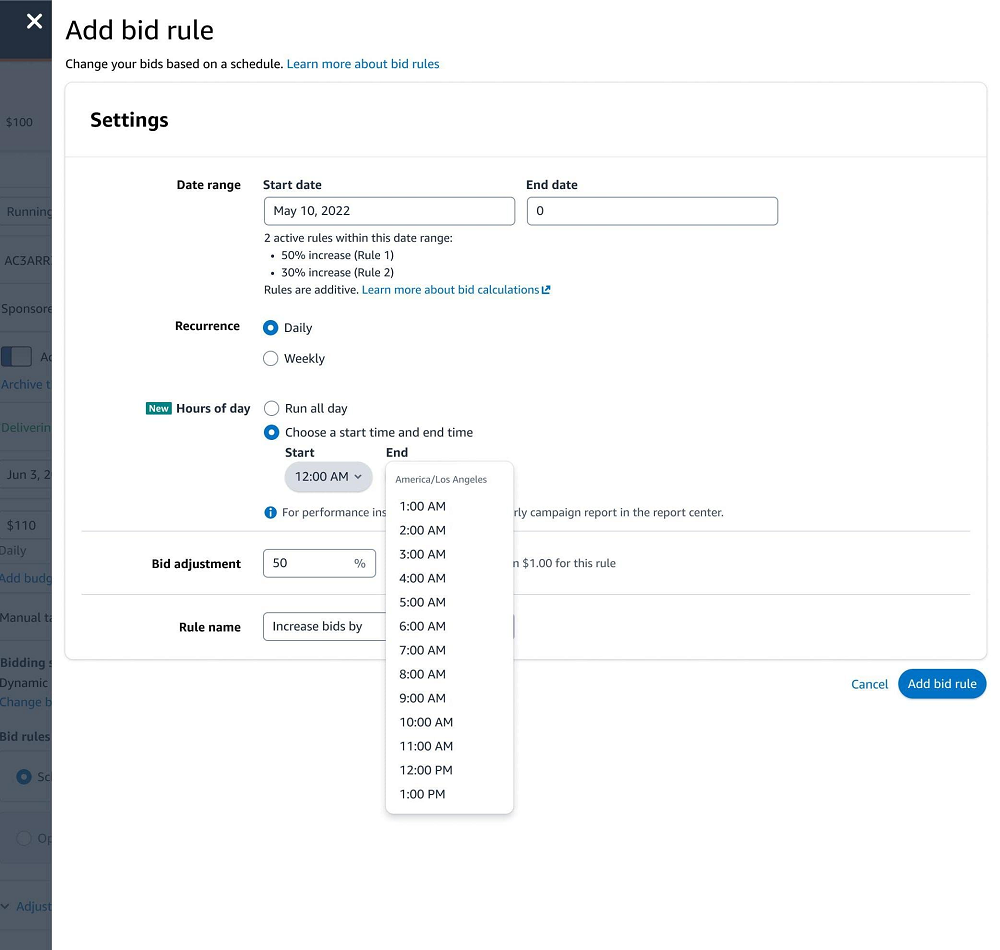
Step 3: Test and Monitor Continuously
A/B Testing: Conduct regular A/B tests to validate your dayparting strategy. Test different bid adjustments across time windows and analyze the results to determine which configurations yield the best performance.
Real-Time Monitoring: Leverage Amazon Marketing Stream for real-time performance insights. Adjust your bidding strategy weekly or biweekly to align with evolving customer behavior and product demand.
Step 4: Avoid Over-Optimization
Start with broader time blocks (e.g., 2-4 hours) rather than segmenting bids by exact minutes. This reduces complexity and enables the algorithm to adjust ad placements efficiently.
Ready to Maximize Your Amazon PPC Ads Performance with Dayparting?
Partner with us to implement targeted dayparting strategies that help lower your ACoS, increase your ROAS, and drive better results.
Key Amazon PPC Dayparting Strategies for Sellers
1. Avoid the CPC Rush with Bid Adjustments: The CPC bid rush right after daily budgets reset can lead to inflated costs with fewer conversions. By reducing bids during this period, you can avoid paying higher-than-necessary CPC. Consider using lower bids during the first few hours after midnight and allocating your budget to more productive periods, such as late morning and early evening.
2. Leverage Additive Nature: Dayparting complements existing bid modifiers, such as Top of Search (TOS) placements. By combining schedule-based bid adjustments with TOS modifiers, sellers can optimize bids and ensure higher visibility during peak times. This synergy helps boost performance without overcomplicating bid strategies, ensuring maximum exposure when it matters most.
3. Use AI-Powered Dayparting Tools: While Amazon doesn’t offer native dayparting features, third-party tools use AI to optimize PPC campaigns. These tools analyze historical data and automatically adjust bids based on patterns, ensuring that your budget is allocated efficiently.
Note: “While AI-driven bidding tools excel at high-frequency automation, they are prone to ‘Black Box’ algorithmic aggression, where the logic behind aggressive bid spikes remains opaque and decoupled from broader business health. Without manual oversight, these tools may over-optimize for short-term conversion signals at the expense of profitability, necessitating human intervention to manage complex trade-offs—such as balancing peak-hour performance with inventory levels and strict daily budget constraints.
To establish the strategic guardrails necessary to maintain a competitive edge, many brands are turning to industry leaders in this space. Explore our curated list: Top Amazon Advertising Agencies Helping Brands Scale with Maximum ROI in 2026.
Best Practices of Dayparting for Amazon PPC
1. Track Hourly Performance with SP Hourly Reports
SP Hourly Reports provide granular insights into how your ads perform at different times of the day. By analyzing these reports, you can pinpoint your campaign’s most profitable hours and adjust bids accordingly.
2. Monitor Campaigns Regularly
Dayparting isn’t a set-it-and-forget-it strategy. Regularly review your campaign performance for evolving consumer behaviour and make adjustments as needed.
3. Optimize for High-Conversion Times
Peak conversion times typically include lunch hours (11:00 AM – 1:00 PM) and evenings (6:00 PM – 9:00 PM). However, these periods can vary depending on your product category and target audience. Use SP Hourly Reports to identify these patterns and prioritize your budget during these time slots.
4. Test & Optimize
Dayparting requires continuous testing to ensure optimal bid adjustments. Experiment with different bid levels at different times and track the impact on performance. A/B testing helps refine your strategy and improves overall ad efficiency.
Limitations & Challenges of Dayparting for Amazon PPC
1. One-Way Bidding Control
Amazon’s native schedule-based bid rules support bid increases only during defined time windows. There is no equivalent mechanism to programmatically decrease bids during off-peak hours. As a result, dayparting functions as a selective bid amplification strategy, not a true bid modulation model. Cost control during low-conversion periods still relies on indirect methods such as budget exhaustion or manual intervention.
2. Requires Manual Setup
Since Amazon does not offer native dayparting, implementing a granular time-based bidding strategy requires manual adjustments or reliance on third-party tools, which can be time-consuming for large campaigns.
3. Availability Only for Sponsored Products
Scheduled bid and budget rules are currently only available for Sponsored Products campaigns. This means that advertisers cannot apply these features to Sponsored Brands or Sponsored Display campaigns, limiting the ability to implement dayparting across all ad types on Amazon.
4. Scalability
Managing schedule-based bid and budget rules for multiple campaigns can be time-consuming, as each campaign requires its own independent bid schedule. This becomes particularly challenging for large accounts with many campaigns, making it difficult to scale dayparting strategies efficiently.
5. Dependence on Data Granularity and Accuracy
Dayparting effectiveness is constrained by the granularity and accuracy of Amazon’s hourly performance data. Amazon’s native reporting may not always provide sufficiently detailed hourly insights across all metrics, making it harder to pinpoint precise conversion peaks and valleys, which can lead to less reliable bid and budget adjustments if not analyzed carefully.
How Data4Amazon Can Help with Amazon PPC Optimization?
- End-to-End PPC Management: Comprehensive campaign setup, management, and optimization across Sponsored Products, Sponsored Brands, and Sponsored Display.
- Advanced Bid and Budget Optimization: Utilize rule-based systems and expert manual adjustments to maximize visibility and efficiency during peak hours.
- Continuous Performance Monitoring: Daily, weekly, and monthly adjustments based on key metrics like ACoS, ROAS, CTR, and CVR.
- Cross-Format Integration: Optimizing PPC alongside brand storefronts, video ads, and retargeting for full-funnel marketing.
- AI-Powered Optimization: Leverage AI-powered tools to automatically adjust bids and budgets, ensuring efficient spend allocation and continuous campaign refinement based on real-time data patterns.
- Data-Driven Reporting: Real-time dashboards and detailed reports to track ad spend, performance, and strategic adjustments.
Want to Optimize Your Amazon PPC Campaigns with Dayparting?
Partner with our experts to implement data-backed bid strategies and drive higher conversions with lower ACoS.